SONEL- Earthing resistance and soil
SONEL
SONEL- Earthing resistance and soil
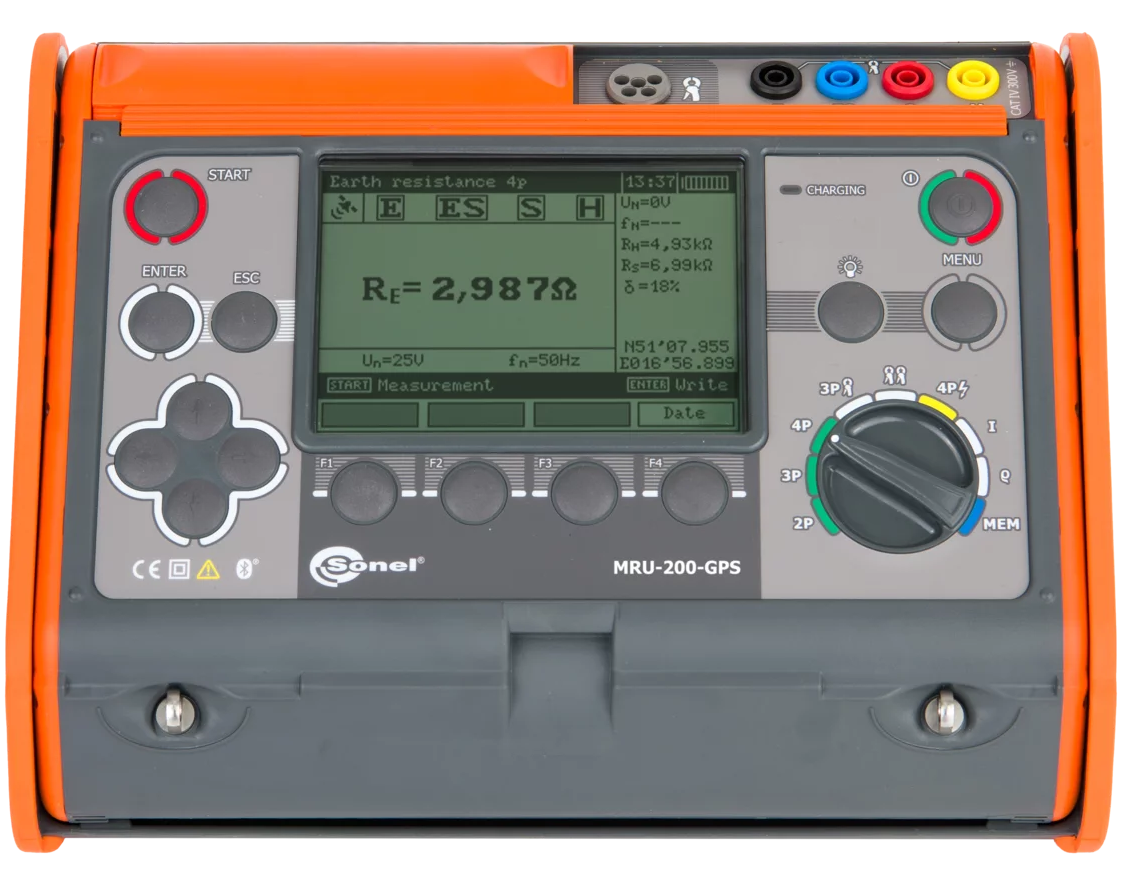
Multifunctional earthing and soil resistivity meter
The Sonel MRU-200-GPS earth resistance and soil resistivity meter is a versatile meter for earth resistance and soil resistivity measurements. The device allows the use of all known earth resistance measurement methods. This renders it an unrivalled measuring instrument in its category and definitely makes it stand out from other devices of its kind. Sonel MRU-200-GPS allows you to perform tests with the 3-pole and 4-wire method, using additional clamps (multiple earthing), as well as the two-clamp method and impulse method (earth impedance measurement).
The application of the two-core measurement method allows, under certain conditions, to perform earth resistance measurements without the use of auxiliary probes which are driven into the ground. The impact method, on the other hand, is used for diagnosing lightning protection earthing, but can also be used to measure extensive, multiple and connected earthing (including underground) without interfering with the circuit. With the use of the impact method it is possible to carry out measurements in accordance with EN 62305 - the need to measure earth impedance. It is worth noting that the instrument also has a built-in GPS receiver, which allows for recording the result along with the coordinates of the location. An additional function of the meter is the possibility of carrying out measurements of soil resistivity, continuity of protective and equalising connections and, with the use of clamps, also leakage or fault currents.
The high class of the device is confirmed by the excellent accuracy of the result it produces. The meter makes measurements in accordance with the EN 61557 standard starting from 0.100 Ω.
Measurement methods
- Impulse method – measurement of lightning protection systems with a measuring impulse ramp of 4/10 μs, 8/20 μs, 10/350 μs
- 3-pole and 4-wire method – measurement of earthing systems using auxiliary probes
- 3-pole method with clamp – measurement of earthing systems with multiple earth electrodes
- Two-clamp method – measurement of earthing system when the auxiliary probes cannot be used
- Earth resistivity – Wenner method
- Resistance of earth and compensatory conductors measured using current ≥200 mA with auto-zero function – meets the requirements of EN 61557-4
- Measurement of leakage current
- Built-in GPS receiver – recording results with location coordinates
- Measurement of resistance of auxiliary electrodes RS and RH
- Measurement of interference voltage
- Measurement of interference frequency
- Measurement in the presence of interference voltage generated by power networks with frequency of 16 2/3 Hz, 50 Hz, 60 Hz, 400 Hz
- Selection of maximum measuring voltage (25 V and 50 V)
- Automatic calculation of soil resistivity in ohm-meters (Ωm) and ohm-feet (Ωft)
- Memory of 990 measurement results (10 banks of 99 cells each)
- Calibration of clamp used
- Real time clock (RTC)
- Data transmission to the computer and mobile devices
- Battery indication
- The four-lead method provides very accurate measurement of the expected small values of resistance – eliminates the resistance of the test leads connecting the meter to grounding.
- Measurement of the continuity of protective connections and equipotential bondings with a current exceeding 200 mA meets the requirements of EN 61557-4 standard.
- Before performing the measurement, the meter checks whether the tested object is a subject to excessive interference voltage, which may indicate additional problems.