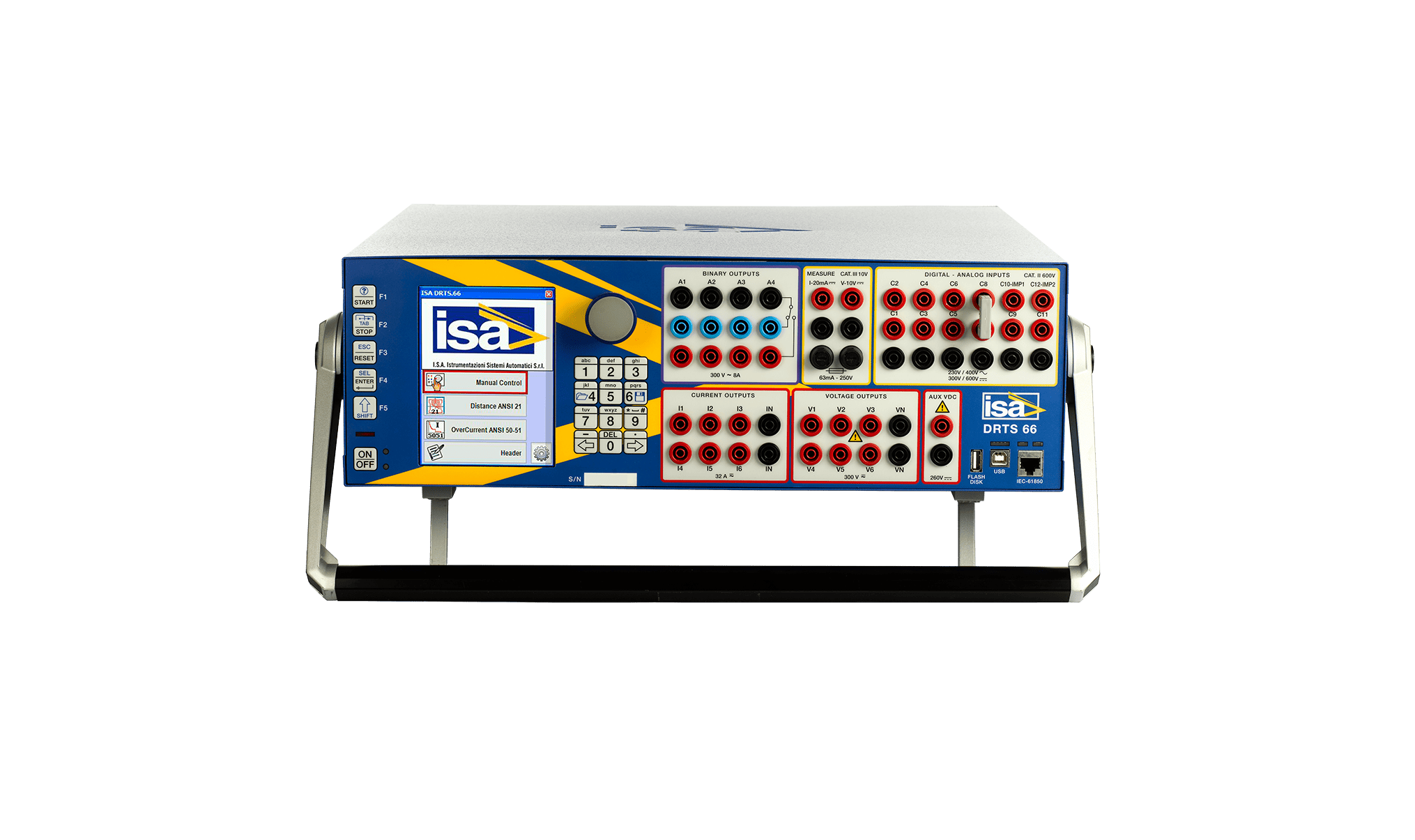
RELAY TEST KIT
RELAY TEST KIT
Introduction:
The DRTS series is a powerful, high-precision diagnostic test system designed for accurate testing of protection relays, transducers, energy meters, power meters and power quality meters. The advanced test equipment is engineered to meet the demanding requirements of commissioning, testing and maintenance of electrical substations. The DRTS series provides up to 6 current and 6 voltage generators simultaneously, offering exceptional flexibility for testing a wide range of protection and measurement devices.
Advanced Operation and Control
The DRTS test sets can be operated directly from the front panel using a large colour graphical display, rotary selector, keypad and dedicated function keys. For PC-based operation, the test sets are equipped with USB and Ethernet interfaces, enabling seamless control through the advanced TDMS testing software. An optional Local Touch Control module is also available, featuring a touchscreen interface that can be used either attached to or detached from the test set, providing enhanced flexibility and ease of operation in the field.
DRTS – High-Performance Test Solution
The DRTS represents the leading edge of Doble_ ISA's relay and meter testing technology. It is designed for high-precision testing of protection relays, Class 0.1 energy meters, transducers and other electrical measurement devices.
Using advanced multiple-DSP technology, the test set generates high-precision signals with an accuracy of up to 0.05%. The DRTS platform is available in four hardware configurations:
- DRTS 66: 6 current and 6 voltage generators + 1 battery simulator
- DRTS 64: 6 current and 4 voltage generators + 1 battery simulator
- DRTS 34: 3 current and 4 voltage generators + 1 battery simulator
- DRTS 33: 3 current and 3 voltage generators + 1 battery simulator
High-Power Outputs
The DRTS test sets feature powerful output capabilities suitable for testing virtually all types of protection relays, including electromechanical relays. The high-performance outputs include: Current outputs: 3 × 64 A at 860 VA & Voltage outputs: 3 × 300 V at 100 VA.
These capabilities provide the high power and flexibility required for demanding relay-testing applications. The DRTS series incorporates an IEC 61850 protocol interface, enabling comprehensive testing of modern protection relays and intelligent electronic devices (IEDs) that communicate through Ethernet-based substation communication networks. With its combination of high-precision signal generation, flexible hardware configurations, powerful outputs, advanced software control and IEC 61850 capabilities, the DRTS series provides a comprehensive solution for protection relay testing, energy meter testing, commissioning and substation maintenance.
Technical Specification:
The test set shall provide multiple current and voltage output ranges. The current output shall be configurable as 6 × 0–32 A AC, 3 × 0–32 A AC, 3 × 0–64 A AC, 1 × 0–96 A AC, and 1 × 0–128 A AC.
The voltage output shall include 6 × 0–300 V, 4 × 0–300 V, 1 × 0–600 V, and 1 × 0–600 V.
The power output shall be 6 × 430 VA at 32 A, 3 × 430 VA at 32 A, 3 × 860 VA at 64 A, 1 × 1000 VA at 64 A, and 1 × 1000 VA at 64 A.
Additional voltage power outputs shall include 3 × 100 VA at 125–300 V, 3 × 100 VA at 125–300 V, 4 × 85 VA at 125–300 V, 4 × 85 VA at 125–300 V, 6 × 50 VA at 125–300 V, 1 × 200 VA at 125–300 V, 1 × 200 VA at 125–300 V, 1 × 200 VA at 600 V, and 1 × 200 VA at 600 V.
The output frequency for both current and voltage outputs shall be adjustable from 0 to 3000 Hz. For voltage outputs, the maximum frequency shall be 3 kHz at 60 V, 2 kHz at 100 V, and 700 Hz at 300 V. The transient frequency range shall be 0 to 5000 Hz. The test set shall provide the capability to program up to 12 different frequencies on all outputs. The maximum frequency error shall be 0.5 ppm, with a frequency resolution of less than 5 µHz.
The phase-angle range shall be –360° to +360°, with a resolution of 0.001°. The phase-angle accuracy for voltage and current outputs at 50/60 Hz shall be 0.01° typical and 0.02° guaranteed.
The battery simulator shall provide an output range of 0–260 V DC at up to 1 A, with a power rating of 50 W or 1 A and an accuracy of 2%. Connections shall be provided through 4 mm banana sockets.
The test set shall include six low-level signal outputs, each providing a full-range voltage output of 7.26 Vrms and a maximum output current of 5 mA. The resolution shall be 0.43 mV, with an accuracy of 0.015% typical and 0.05% guaranteed. The frequency bandwidth shall extend from DC to 20 kHz. The low-level signal outputs shall be available through a multipole connector located on the rear side of the test set.
The unit shall provide 12 binary inputs with galvanic isolation arranged in six groups of two inputs, with six common points isolated from one another. The inputs shall support potential-free signals or voltage inputs from 4.5 to 300 V DC and 24 to 230 V AC. When the Transcope option is installed, the maximum permissible input voltage shall be 600 V DC or 425 V AC. Input types shall be selectable as dry, 5 V, 24 V, 48 V, or 100 V. Trigger conditions shall include normally open (N.O.), normally closed (N.C.), edge and Boolean conditions, with each input independently configurable. The timer range shall be unlimited, with a timer resolution of 0.01 ms and an accuracy of 0.001% of the measured value ±0.1 ms. The sampling rate shall be up to 10 kHz, or up to 50 kHz when the Transcope option is installed. Connections shall be provided through 4 mm banana sockets.
Two counter inputs shall be provided, supporting pulse frequencies from 0 to 100 kHz. Connections shall be through 4 mm banana sockets. The test set shall also include four potential-free, timed binary relay outputs with make-and-break contacts. For resistive loads, the relay contacts shall be rated at 300 V AC, 8 A, and 2400 VA, or 300 V DC, 8 A, and 50 W. Programmable time delays shall range from 0 to 999,999.999 seconds. Connections shall be provided through 4 mm safety banana sockets.
In addition, four binary transistor outputs shall be provided. These shall be dry, open-collector transistor outputs with a rating of 24 V and 5 mA. The outputs shall include short-circuit protection and protection against voltages higher than 24 V. Programmable time delays shall range from 0 to 999,999.999 seconds, with a timing accuracy relative to the test start of 50 µs. The connections shall be made through a dedicated multipole connector located on the rear side of the test set.
The test set shall include analog DC measuring inputs comprising one DC current measuring input with selectable measuring ranges of ±20 mA and ±5 mA, and one DC voltage measuring input with a measuring range of ±10 V. The DC current measurement accuracy shall be ±0.02% of reading ±0.01% of range for the 20mA range and ±0.05% of reading ±0.02% of range for the 5mA range. The DC voltage measurement accuracy shall be ±0.02% of reading ±0.01% of range. Connections for the analog DC measuring inputs shall be provided through 4 mm banana sockets.
The test set shall have 256 MB of internal memory, sufficient to store approximately 2,000 test results. A pen-drive interface shall be provided for saving and recalling local test settings and test results. Communication interfaces shall include USB and Ethernet as standard, with IEC 61850 and IRIG-B available as optional interfaces. The USB interface shall have a transmission rate of at least three times the minimum specified rate and shall be supplied with a 2 m interface cable. The Ethernet interface shall use an RJ-45 connector and shall be supplied with a 2 m interface cable. The optional IEC 61850 interface shall also use an RJ-45 connector and shall include a 2 m interface cable. The optional IRIG-B interface shall be provided through an ST-type fiber-optic connector.
The test set shall operate from a single-phase, sinusoidal mains supply of 85–264 V AC at a frequency of 45–65 Hz. Power consumption shall be less than 150 W in standby mode, up to 1600 W at maximum load with a 115 V supply, and up to 2700 W at maximum load with a 230 V supply. The mains connection shall be through a standard 16A AC socket.