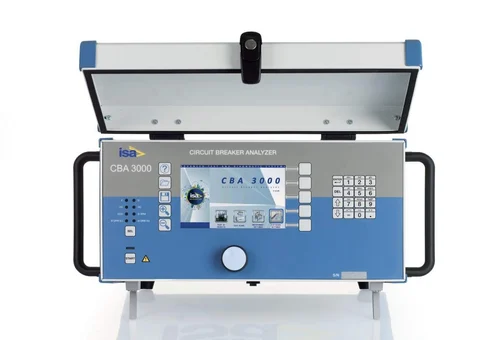
CIRCUIT BREAKER ANALYSER
CIRCUIT BREAKER ANALYSER
Introduction:
The CBA 3000 Circuit Breaker Analyzer is a comprehensive test system designed for the offline testing and analysis of medium-voltage (MV) and high-voltage (HV) circuit breakers. It combines timing analysis, motion and speed measurements, static and dynamic contact resistance measurements, Both Sides Grounded (BSG) testing, undervoltage trip-coil testing, and several other diagnostic functions in a single, lightweight test set. The CBA 3000 is designed to make circuit breaker testing safer, faster, and more accurate. A single connection setup can be used to perform multiple circuit breaker tests automatically, eliminating the need for additional external modules. The instrument measures circuit breaker operating times in accordance with IEC 62271-100 and can perform static contact resistance measurement (SCRM) as well as dynamic contact resistance measurement (DCRM). DCRM records how the contact resistance changes during the opening or closing operation, helping identify hidden defects that may otherwise remain undetected.
Key Advantages:
- Faster: A single connection setup enables automatic execution of multiple circuit breaker tests.
- Safer: Both Sides Grounded (BSG) testing can be performed without additional external modules.
- Comprehensive: Timing, motion, speed, acceleration, contact resistance, coil current, motor current, pressure, and other measurements can be integrated into a single test plan.
- Fully configurable: Test sequences, inputs, outputs, measurement parameters, and operating conditions can be configured according to application requirements.
- Portable: The complete test system is housed in a rugged, transportable aluminium case.
Key Features:
- Timing tests in accordance with IEC 62271-100
- Motion, speed, acceleration, overtravel, and rebound analysis
- Up to six static and dynamic contact resistance measurements simultaneously
- Up to three integrated micro-ohmmeters, each providing up to 200 A DC
- Both Sides Grounded (BSG) testing, including testing of GIS circuit breakers
- Three-phase first-trip measurement
- 16 fully configurable contact inputs, optionally expandable to 24
- Up to six Open/Close coil commands
- Three analog linear/rotary transducer inputs
- Three digital transducer inputs for travel and speed analysis
- Eight fully configurable analog measurement inputs
- Fully automatic minimum-voltage trip-coil test with the optional module
- On-screen test control and result evaluation
- Large 7-inch colour display
- Ethernet and USB interfaces
- Internal memory of approximately 256 MB, typically storing up to 1,000 test results
- Storage and recall of up to 256 test plans
- TDMS software suite for test execution, analysis, database management, and reporting
- Library of standard test plans supplied with the test set
- Optional 58 mm thermal printer
Circuit Breaker Testing:
The CBA 3000 allows comprehensive offline testing of MV and HV circuit breakers. A programmable test plan can combine several operations, including:
- Timing tests
- Travel and motion measurements
- Speed and acceleration analysis
- Motor current measurement
- Coil current measurement
- Static contact resistance measurement
- Dynamic contact resistance measurement
- Both Sides Grounded testing
- Minimum-voltage trip-coil testing
All required operations can be defined within a single test plan, minimizing setup time and reducing the possibility of connection errors.
Timing Management:
The CBA 3000 provides multiple user-selectable timing triggers. The measurement can be initiated by:
- Internal trigger: Timing starts when the first Open or Close coil command is issued by the driving circuit. Timing accuracy is ±20 μs.
- Coil-current trigger: Timing starts when the first Open or Close coil current exceeds the selected current threshold.
- Auxiliary-input trigger: Timing starts when a selected auxiliary input turns ON or changes state. Logical combinations of auxiliary inputs can also be used as triggers.
- Analog-input trigger: Timing starts when the selected analog input crosses a predefined threshold, either above or below the specified level.
Programmable Test Sequences
The CBA 3000 allows users to create fully configurable test sequences. The following operations can be included in a test plan:
- Open (O): The selected Open coil phase is energized. All-phase and individual phase combinations are available.
- Close (C): The selected Close coil phase is energized. All-phase and individual phase combinations are available.
- OC: Open followed by Close.
- CO: Close followed by Open.
- O-CO: Open, followed by Close and then another Open operation. The first Open command is issued to the selected Open coil phase, while the second Open command can be issued to all coil phases.
- Static Resistance: Measures the circuit breaker contact resistance in the closed position.
- Dynamic Resistance: Records the contact resistance profile during an opening or closing operation and determines the breaker timing based on the measured resistance profile.
Multiple sequences can be combined, such as CO-CO, O-CO-CO, and other user-defined combinations.
The following timing parameters can be programmed for each sequence:
- Open command duration: 1 ms to 10 s
- Close command duration: 1 ms to 10 s
- Open-to-Close delay: 1 ms to 199.990 s
- Close-to-Open delay: 1 ms to 199.990 s
- Dynamic Open/Close measurement duration: 30 ms to 1 s
- Recording duration: 10 ms to 199.990 s
Motion and Speed Analysis
Using analog or digital transducers connected to the CBA 3000, detailed circuit breaker motion analysis can be performed. The system can measure and calculate key mechanical parameters, including: Travel, Speed, Acceleration, Overtravel, Rebound. The enhanced measurement functions in the TDMS software allow movement and speed characteristics to be analyzed in detail, helping identify mechanical abnormalities and deviations from expected breaker performance.
Coil Measurement
The CBA 3000 records the current profile of each Open and Close coil and internally calculates the maximum coil current. Three different current ranges are available for measuring each coil circuit. The recorded current profile can be analyzed together with the timing and command signals, providing a comprehensive view of the breaker operating mechanism.
Static Contact Resistance Measurement
Static contact resistance measurement is performed with the circuit breaker in the closed position. The CBA 3000 can be equipped with up to three integrated micro-ohmmeters, each capable of delivering high test current. This configuration allows simultaneous measurement of multiple breaker contacts.
Micro-Ohm Meter and Current Generator
- Output current: 200 A, 150 A, 100 A, 50 A, or 25 A
- Resistance ranges: 250 μΩ, 1 mΩ,10 mΩ, 50 mΩ,500 mΩ
- Minimum resolution: 0.1 μΩ
- Contact resistance accuracy:
- ±0.2% of reading ±0.2% of range for 250 μΩ and 1 mΩ ranges
- ±0.3% of reading ±0.3% of range for 10 mΩ, 50 mΩ, and 500 mΩ ranges
- Maximum test voltage: 5 V
Dynamic Resistance Measurement
Dynamic Resistance Measurement records the main contact resistance continuously during the opening or closing operation of the circuit breaker. The test current flows through the breaker contacts while the CBA 3000 records variations in contact resistance throughout the operating cycle. The resulting resistance profile provides valuable information about contact behaviour and can reveal defects that may not be detectable through conventional static resistance measurements. Test current, resistance ranges, and other measurement characteristics are the same as those specified for static contact resistance measurement.
Both Side Ground Test
Safety is a key feature of the CBA 3000. The integrated Both Sides Grounded (BSG) function allows circuit breaker timing tests to be performed while both sides of the circuit breaker are connected to ground. This significantly enhances operator safety during testing. Using the integrated micro-ohmmeters, the CBA 3000 can measure the operating time of the main contacts even when both ends of the circuit breaker are grounded. The BSG function is particularly suitable for applications involving GIS circuit breakers and other installations where maintaining both-side grounding during testing is required.
Technical Parameters:
Coil command circuits
Number of circuits: 2, 4 or 6
Type of driver: electronic; it ensures superior timing control
Driver characteristic: 300 V DC max; 60 A DC max; 300 V AC max; 42 A AC max
Operating time accuracy: 0.025% of delay ± 20 us
Coil current ranges: 3; 10; 60 A full scale, user selectable
Coil current measurement accuracy: 0.1% of the reading ± 0.1% of the selected range
Outputs are isolated between them and between ground
Timing contact inputs (main / pir or auxiliary)
Number of contact inputs: 16 (optionally 24), divided in 8 (optionally 12) groups of two each
Each input group is isolated with respect to the others
The contact inputs may be configured as main/PIR breaker contact or auxiliary contact
The contacts status (closed or opened) are displayed on the screen
Main/PIR breaker contact
Test of the main contact and of the pre-insertion resistor contact, selectable
PIR resistance range: 30Ω to 10kΩ
PIR resistance measurement value (optional) accuracy : ± 2% of the reading ± 0.1% of the range. The contact is closed when the contact resistance is less than 10Ω
Contact test voltage: 24V; test current: 100mA
Auxiliary contacts
Capability of testing dry contacts. Contact test voltage: 24 V; test current: 5 mA .
Capability of testing wet contacts. If wet, the input contact has these characteristics: Voltage threshold: 15V / 77V or programmable with steps of 5V (for PIR resistance measurement value option), Impedance: >150kΩ or > 500kΩ (for PIR resistance measurement value option)
Contact selection: (dry or wet with thresholds) can be different on the groups.
Auxiliary binary output
One relay auxiliary output
Characteristics of the contacts with a resistive load: AC: 300V; 8A; 2400VA - DC: 300V; 8A; 50W
The contact operation can be timed with respect to test start
Inputs time measurement
Sample rate: from 10Hz to 100kHz maximum
Resolution: 0.01ms to 100ms
Inputs timing accuracy: see the following table
Analog inputs
Number of analog inputs: 8, fully programmable. Common characteristics of analog inputs Measurement resolution: 16 bit
Number of ranges : three. 300Vac (420 Vdc peak), 10Vdc, 1V DC
Measurement accuracy: 1 V range : ± 0.2% of the reading ± 0.2% of the range, 10 V range : ± 0.1% of the reading ± 0.01% of the range, 420 V range : ± 0.5% of the reading ± 0.1% of the range
Input impedance: more than 600kΩ
Measurement sampling rate: 100kHz max
Number of insulated and independent neutrals: 4
Two groups of three channels each (to be used, for example, as transducer inputs for motion analysis and for voltage coming from micro-ohmmeter) and two different neutrals for the remaining two channels (for monitoring motor current or DC coil supply).
Voltage value: + 5 V; maximum output current 30 mA; minimum transducer resistance 170Ω. It is also available a +12V supply with the same power.
Insulation between different neutrals: 1kV AC
Digital transducer inputs
CBA 3000 allows monitoring up to three digital transducers at the meantime.
Maximum input frequency: 50kHz
Interface: RS422
Accepted transducers: up to 5000 impulses
Connection: by three multi-pole connectors used also for the analog inputs
Other characteristics
Mains supply: - From 85 to 265V AC; 47-63Hz & From 120 to 350V DC.
Maximum supply current: 3.6A @ 100V AC or 1.8A @ 200V AC; maximum power consumption: 360 VA . Housing: aluminium case, with hinged removable cover and handles.
Dimensions: 407 x 450 x 230mm.
Weight: 15kg
Available Models: CBA-1000, CBA-2000, CBA-3000
Product Link: https://www.doble.com/product/cba-3000/