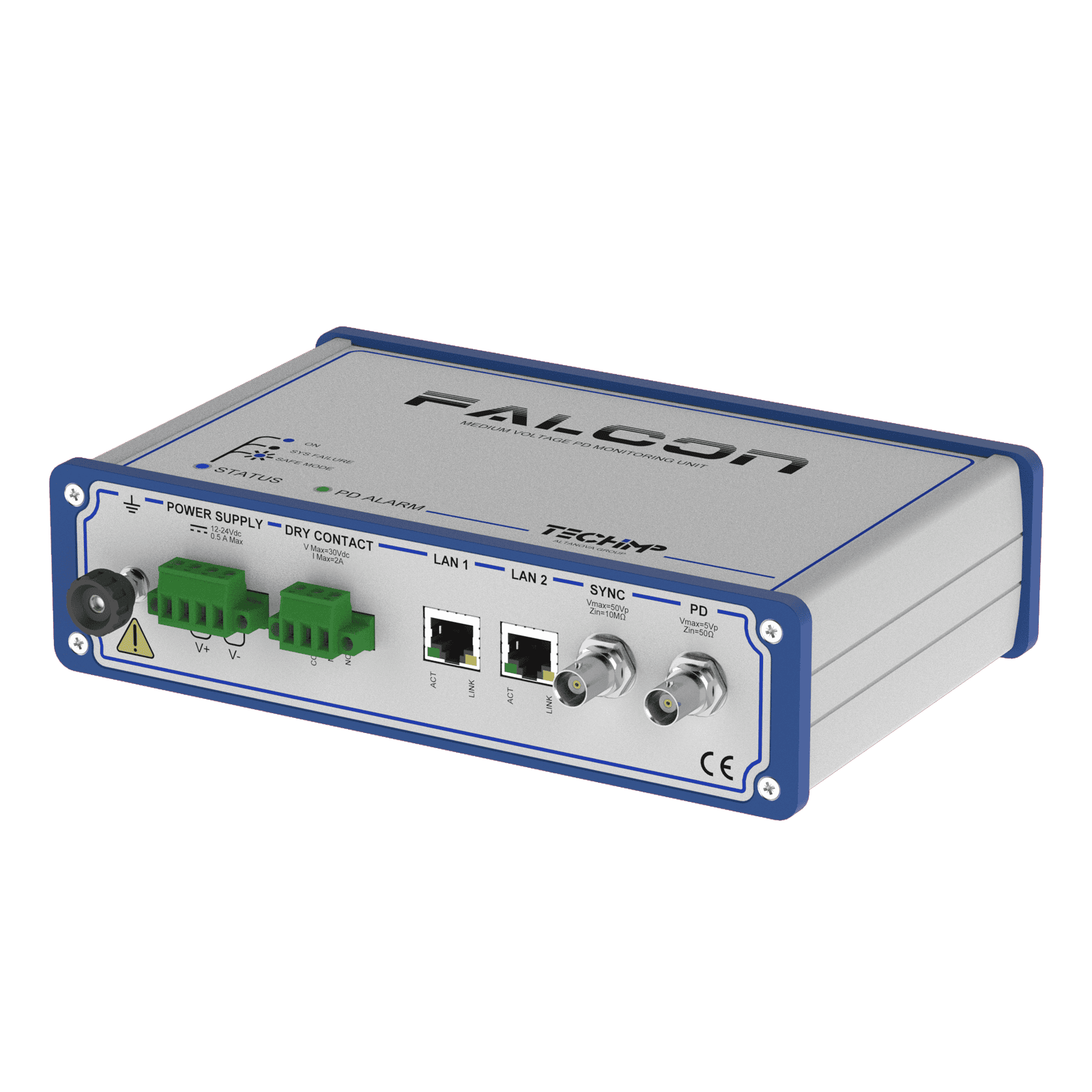
PLUG AND PLAY MONITORING
PLUG AND PLAY MONITORING
Introduction:
FALCON represents the state of the art in Partial Discharge Monitoring (PDM) for Medium Voltage (MV) assets, combining proven and patented technologies originally developed for High Voltage asset monitoring with the economic and operational requirements of MV networks. FALCON acquires and processes high-frequency Partial Discharge (PD) signals locally through connected sensors, including inductive High-Frequency Current Transformers (HFCTs) and capacitive Transient Earth Voltage (TEV) sensors. Designed as an economical solution for continuous, non-invasive monitoring of partial discharge activity in MV equipment, FALCON enables early detection of insulation deterioration and the progressive degradation of asset condition—providing valuable time to take preventive action before a critical failure or catastrophic breakdown occurs.
FALCON introduces a novel approach to the continuous monitoring of PD phenomena across an integrated network of Medium Voltage equipment. The system is specifically designed to address the key requirements of MV grids by providing:
- Non-invasive PD monitoring
- Cost-effective deployment
- Fully automatic data acquisition and processing
- Automatic noise rejection
- Automatic identification of increasing PD trends
- Continuous assessment of MV asset condition
By combining local signal acquisition with onboard processing and intelligent data analysis, FALCON minimizes the need for continuous human intervention while providing actionable information on the evolving condition of electrical assets.
FALCON integrates onboard computing power and data storage, together with a convenient web-browser interface. The unit can be accessed remotely from anywhere within the network, allowing users to analyze PD measurements and historical trends without the need to transfer large volumes of raw data. Local processing significantly reduces communication requirements and enables efficient remote monitoring, even where network bandwidth is limited. The system's easy installation and automatic configuration (auto-setting) further reduce commissioning time and simplify deployment across MV installations.
FALCON incorporates patented T/F-map technology and an ultra-wideband acquisition system capable of capturing comprehensive information from individual PD pulses.
The acquisition system records:
- PD pulse amplitude and phase
- PD pulse waveform
- Time-domain characteristics
- Frequency-domain characteristics
The captured pulse waveform provides additional information about the physical characteristics of the discharge, enabling the pulse shape itself to be used as a diagnostic parameter.
For each acquired PD pulse, FALCON automatically calculates its time and frequency content, generating the proprietary Time-Frequency (T/F) map. This approach provides a powerful means of characterizing PD activity, distinguishing relevant discharge phenomena from interference, and monitoring changes in insulation condition over time.
By combining advanced sensing, local intelligence, patented signal-processing technology, automatic noise rejection, and remote accessibility, FALCON provides a practical and scalable solution for the continuous condition monitoring and early detection of insulation degradation in Medium Voltage assets.
Easy to Install:
A FALCON KIT comes with a sensor, a synchronization kit and the web application. FALCON is a plug and play device, that can be installed with only a few simple operations. It configures itself automatically and, once powered, it is immediately operational. Another important advantage of FALCON is its capability to be easily integrated into an existing monitoring system. FALCON supports the IEC 61850 protocol. The FALCON Unit is equipped with two magnets which allow the unit to be installed directly on the panel of the switchgear or with a DIN rail, for a different type of installation.
Automatic Alarm:
There are several ways to visualize and monitor incoming alarms:
- LED indicator on the unit: The LED is green when FALCON detects no activity and turns red when harmful activity is detected.
- Dry contacts: Dry contacts can be connected to any local SCADA system for integration with existing monitoring and control infrastructure.
- FALCON Web Application: Easily accessible through any web browser on a laptop, tablet, or smartphone, the web application provides: The asset status using intuitive traffic-light logic, A list of alarms associated with partial discharge activity, A list of system notifications, including communication issues and equipment malfunctions, Trends and key statistical parameters, such as Qmax, repetition rate and alarm history.
- IEC 61850 or OPC UA: FALCON can also integrate with higher-level monitoring and automation systems through IEC 61850 and OPC UA communication protocols.
The alarms are given with 5 levels of severity:
GOOD: Situation of stability.
MODERATE: Birth of a phenomenon showing a very slow evolution. In this case it is advisable to schedule a further diagnostic intervention a few months later.
SLIGHTLY DETERIORATED: The phenomenon identified is growing.
DETERIORATED: It is advisable to schedule a further diagnostic intervention.
CRITICAL: The intervention must be scheduled as soon as possible.
All the information acquired is stored in FALCON memory and it is available via web application, PC, or smartphone. When an evolving defect occurs, the web application immediately reports the condition of the asset and the criticality level of the defect. The interface is easy to read and doesn’t require any specific skills. It is therefore not necessary to be a partial discharge expert to use the FALCON system.
Technical Parameters:
Partial Discharge
PD channel quantity: 01
Bandwidth: 16 kHz, 30 MHz
Sampling frequency at full bandwidth: 125 MS/s
Resolution: 12 bit
Sensitivity: 1,10000 mVpeak
Full Scale: 5 V peak
Input impedance: 50 Ω
Pre-trigger: 0,100% @ 100μs
Connector type: BNC
Synchronization Input
Channel quantity: 1
Frequency range: 5-500Hz
Input impedance: 10 MΩ
Sampling frequency at full bandwidth: 1MS/s
Resolution: 12 bit
Connector type: BNC
Communication System
Ethernet connector type: 10/100/1000 Mb/s, 2 LAN ports
Communication Protocol: OPCUA - IEC 62541, IEC 61850, Modbus, DNP3
Power supply: 12 / 24 VDC, 1A
Standard Of Compliance: CE Marking Directive, IEC 61326 (EMC) Electro Magnetic Compatibility, IEC 61010 (LVD) Low Voltage Directive, IEC 60068-2-6 Environmental testing - Test Fc: Vibration (sinusoidal), IEC 60270 IEC 60034-27 IEEE 1434-2014 High-voltage test techniques - Partial discharge measurements Deviation: Magnitude of the apparent charge is measured in mV.
Available Models: FALCON, FALCON-4, FALCON-MK
Product Link: https://www.doble.com/product/falcon-1/